Saturday, October 6, 2012

Organizing Your Classroom Library


Hopefully your biggest problem in your classroom library is how to organize the hundreds of books you have.  If you're still needing more books for your class library, head to my Finding Great Books on a Dime blog ( http://applesofyoureye.blogspot.com/2012/10/finding-great-books-on-dime.html ).  I was very lucky as a first year teacher because I started teaching the same year that my uncle retired from 25 years of dedicated service to the education profession and bequeathed to me boxes full of amazing books (he chose carefully for his class library and had some great titles perfect for late elementary school age students).  I also had a few dozen books from my own childhood and a couple of boxes from garage sales.  There were even dozens of books left for me by my amazing mentor teacher, Jaqui Forney, who I had student taught with in the same classroom two years before!  I was very blessed in terms of a starting classroom library, and I've added a few hundred books to our collection thanks to DonorsChoose.Org grants and Scholastic Book Club orders.  Above is a glimpse of part of our classroom library; the green bookshelf to the left houses our class set of dictionaries as well as the first and second grade level books (each get their own shelf) and our third grade level books (which take up the two bottom shelves).  Without fail, I have had a kindergarten/first grade level reader every year as well as high school level readers, so a good variety of books is essential!

There are many ways to organize a classroom library, and each grade level and teacher will be a little different.  The way I organize my books probably works best for 3-12 grade, but some teachers prefer to have their libraries organized by genre, especially in the younger grades.There are a few reasons why I organize my books by reading level.  The first is research.  If a child is reading a book where they don't comprehend at least 90% of what they're reading, they will be at the frustration level and will get very little out of the text, let alone build a life-long love of reading.  Some research puts the percentage of required comprehension as low as 80% to reach frustration, but anyone who has tried learning another language and attempts to read something that's beyond their current comprehension level will know this frustration first hand.  Research has also shown that a student's independent reading level should include books for which they comprehend about 95% of the words on each page, and that only for the instructional level should we bring them down to only knowing 90% of the words (At least I got that much from my Reading Endorsement, although I am too lazy to actually cite my sources since I'm not being graded! :).  This is one reason that I level nearly all of my books and organize them by reading level- so that students will find a "just right" book that will build their vocabulary while increasing their love of reading and building their comprehension.  Here are some of the titles on one of our fifth grade level shelves:

Another reason I can get away with this is that I know the books in my library.  No, I don't have them all memorized in alphabetical order or anything, but I have a general idea of what books I have in my library and could probably rattle off a few hundred titles.  When a student is struggling to find a good book, I can ask them about what type of book they like (funny books, mysteries, animal books, adventure, etc).  With that in mind, we go to the shelves that have their book level on them, and I can pick out about 5 books that suit their reading interests and have them excited to bring their favorite three back to their desk to put inside their book bag within 5 minutes (I use a gallon sized Ziploc bag instead of book boxes to save space and have them easily accessible).

We use the STAR Reading Test to get a general feel for each student's reading level.  I also do a quick vocab test (I'll have to save that for another post) with each student within the first few weeks of school.  Using an average of those two scores and what I've seen from their classwork, I tell them a grade equivalent reading level.  If they are at a 4.2, they record that number in their "My Reading Level" of their Literacy Journal (see http://applesofyoureye.blogspot.com/2012/08/literacy-journal-organization-sections.html ) and they also write 3.2-5.2.  This means that they can get any book in our classroom library that is within a grade level of their scores (between a 3.2 and a 5.2) to do the "Five Finger Test" with to see if it is a just right book.  As you can see in the picture below, I just use a tiny piece of a label to hand write the book's level and stick it to the spine.


All my students are trained on the "Five Finger Test."  I don't know who made up this little method of finding a good fit book, but it mostly assures students that they'll get a book that will be at their independent reading level.  A student turns to a full page of text in the book they're interested in and starts reading.  As soon as they get to a word that they're not sure about (they couldn't give a definition or use it in a novel sentence) they put a finger up, preferably their pointer finger.  They continue reading until they reach the end of the page (usually about 100 words in an average chapter book).  If they knew every single word on the page well, the book is too easy; they find a different book that will help them build their vocabulary a bit more.  If there were one or two words that they weren't sure about on the page, it's a just right book and they can keep it in their book bag.  If, after reading the page, they had three or more fingers up, it is probably not quite at their level yet, and they should look for a book just a titch lower.  Generally speaking, I find that some students will claim they know all the words until you have them read it aloud to you and you help them keep track of words they can't decode/define/use in a sentence.  This seems to be especially true for lower level readers who are eager to read harder books but are still building their reading skills.  If students are complaining about not having much in the way of reading material, or that they can't find a book that's at their reading level because they never find any new words, a quick read aloud by them will almost always find some words that they may have missed when reading it independently!

I have leveled all of my chapter books by grade level equivalent (find the conversions for DRA, AR, and so forth with a quick internet search for charts like this one: http://www.thecurriculumcorner.com/wp-content/uploads/2012/07/readinconversiontitle.jpg ).  For example, most of the Amelia Bedelia books are around 1.9, 2.5, 2.7 grade level equivalents.  Scholastic's http://www.scholastic.com/bookwizard/ will help you level your books, but for older books or random ones, you'll have to use your best judgement as to what level they are.  My books are organized by whole number (like all the 2's together on one shelf, all the 3's on another, etc.)  The tall white bookshelf below is for all my fifth grade level books (between 5.0-5.9). To the left is the white book shelf where all the books from 4.0-4.9 are shelved, and the brown bookcase to the right holds all the 6.0+ books.  Once my students get above the 6th grade reading level, they can choose any of the books on the brown bookshelf because there will always be new words in them.

Here is a better view of the brown bookshelf:

 Our fourth grade level books:


 Below is a picture of my bookshelf with the group book sets.  I collected these mostly from Scholastic and they range from Kindergarten to high school reading levels on a variety of subjects.  Most of the reading my students do is from a book they've chosen from the shelves, but I group them homogeneously for the book group.  Each group has a set of three books that are at their level to choose from, and they read the book together and do a variety of projects with each one.

  The only books that I don't label are the huge/non-fiction/class-created books/comics/random ones that I keep in these bins as "Everybody" books.  I mostly just pull them out if they pertain to a particular topic we are covering in class, but other than that, my students only read these during a "read any book to self" time or our buddy reading with a younger class.  They also won't fit on my regular little shelves that are chapter book height or are tricky to level.  I also have about 100 books in separate bins that are from the school district, so I keep them separate from my own books.


 How is your classroom library organized?  What have you found to be helpful when you're guiding students in book selection?  What are you still struggling with in your library, and what's working well?  Leave a comment below, share this with a friend.  Here's to great books!

Classroom Jobs


Want to build the kind of responsibility that sticks with kids for the rest of their lives?  Do you want kids to learn hard lessons the easy way?  Could you use a few less hours of work around your classroom each week so you can get other important things done to provide the highest quality education possible for your students?  Then CLASS JOBS ARE FOR YOU!

You can find my complete class jobs starter set at www.teacherspayteachers.com/Product/Classroom-Jobs-Starter-Pack for only $2, but I'm going to give you a sneak peak here! In my Class Job Starter Pack, you will find a complete list of jobs that are adaptable to your own classroom, a student-friendly job description of each job, further details about each job for the teacher to consider, and a job application that students complete.  There is also a class job list that you can print and laminate, and then use on the wall to write the name of each student next to the job they have.  The complete set will explain pretty much everything to a teacher who wants to hand some responsibility over to her students to make the classroom run like a well-oiled machine!


Sample Job Explanations for the Teacher
Librarian 1- These students make sure all of the books in our classroom library are organized, facing the correct way and on the right shelf.  They also bring to my attention any broken or ill-used books, and check our library check-out list to make sure people are returning our classroom library books from home.
Lights-Turn the lights on and off.
Doorperson- This person holds the door open for our classroom and shuts the doors when things get noisy in the hallway.
Mail Carrier 1 These two students pass out all the papers/bulletins/graded homework/etc to each student’s little mailbox, which are emptied by the students at the end of each day.

Student-Friendly Job Descriptions-
Pencil Sharpener- Sharpen the class pencils so there is always a good supply of sharp pencils and we don’t waste our learning time sharpening them!
Office Runner- Bring things down to the office when the teacher needs you to do so.
Line Caboose- This student stands at the end of our line as we’re walking though the hallways and waits with someone if they have to step out of line to tie their shoe or return to the classroom for a forgotten item.
  
Ready to print job applications, the complete job list ready to post with your students’ names, and complete explanations are included in this set.  Of course, with your purchase, you get to pick my brain and I can help you adapt it to your classroom too! Also, when you buy things from my TeachersPayTeachers store, a teacher’s request on DonorsChoose.org will be a little closer to being funded, and great new supplies will soon be in the hands of our youth.  Your purchase will also help provide food, clothing, shelter, medicine, or the start to a new small business for the world’s most impoverished people through Food for the Poor.  (I give 20% of my profits to charity).  I greatly appreciate your support.

 
A teacher’s job is hard enough as it is without worrying about the dozens of small things that need to be taken care of every day in the classroom.  Leave time for more important things in your schedule while helping your students build responsibility- try class jobs today! Have you tried class jobs in your room?  What positions do you have available to your students?  Which student job has alleviated the most work from your schedule so that you're free to help your students with more important things?  What difficulties are you still having with class jobs? Leave a comment below.

Monday, October 1, 2012

Finding Great Books on a Dime!

Do you need more books for your classroom library?  Have you already spent gobs of money on your classroom, and you don't have hundreds more to spend at Scholastic?  Here are some great ways to expand your classroom library without breaking the bank. 

DonorsChoose.org  If you don't have a teacher account on this site yet, MAKE ONE NOW!  I've won ten different grants and thousands of dollars worth of materials for my school spending just a few hours pleading my case to the public (If you want to donate towards my two current ones, they can be found here- http://www.donorschoose.org/project/multiply-the-fun-math-resources-that-en/823437/ and here- http://www.donorschoose.org/project/write-away-spicing-up-our-writing-with/823421/ ).  There are lots of people out there who want to support you and your students, and this is a great way to increase the scope of your classroom library.  For example, one of the grants that I wrote on Donors Choose was for a set of a few DOZEN books for boys!  While I certainly expect my female students to happily devour titles like The Hardy Boys & Encyclopedia Brown (and they do), I was able to add a set of sports chapter books, the recommended "Best for Boys" set, and a general 4-5 grade set of books to my classroom at no cost to me.  Another grant I wrote earned our classroom a whole set of lower-level reading books to support my below-grade-level readers.  I've also written two different grants for books that my grade alike team shares as we work through the related science units.  Donors Choose is a great way to let the public bless your classroom with the exact books you and your students want, and it takes about an hour of work total (choosing the materials you want, writing the description, and writing thank you notes after you get all the resources!).  This site is also great for a plethora of other products, but this post is about books, so we'll stick to mentioning only the literary goodness for now.  Here's a few of the Hardy Boys set I got from Donors Choose:

It's a good thing we teachers have the summers "off" so that we can get all the work we want to accomplish during the school year done!  Summer is the season of garage sales, and these are fantastic sources for great books.  Especially if you are a new teacher and you don't have much of anything in your classroom library, rummage sales are a great place to pick up a good quantity of books for very inexpensively or free. In my first few years of teaching, I would ask garage sale hosts if I could have the left-over books for my classroom.  Most of the time they were planning on giving the books that didn't sell to charity anyways, and many of them let me just take the boxes of books right then and there!  Garage sales, church sales, and rummage sales are great to pick through, and you can often get books for free from them if you offer to pick them up when the sale is over.

Do you have any friends with kids?  As their children grow out of books, scoop those texts right up!  Ask your friends to put aside any books that they're done with so they can be enjoyed by other kids.  If you have kids of your own, you might go through your own family library and see which books haven't been read in a while.  Get them into the hands of your students!  Examine the following picture to see how even Frederick Jr. the Plant loves books, and your students will appreciate a huge variety too!
 
A number of my favorite childhood books are included in my classroom library.  The ones that are important to me or have sentimental value sit on a special shelf behind my desk and are only available for "teacher permission reading" so I know who has them and know they won't be ruined.  A few of my childhood books weren't all that interesting to my sister and me, so they are interspersed amongst the other texts on the general classroom library shelves.  If you can't bare the thought of losing the book, don't bring it into your classroom, but if you have a few boxes of old books sitting in your attic (or your parent's basement), dust them off and get them into your classroom!

Check with your school library and with local public libraries (or private school libraries) towards the end of the year.  This is usually when they discard books that aren't checked out as frequently or have minor wear or tear on them.  I've gotten some great books from our church's private school and our own school library that have nothing more than a scribble on one page!  Library discards are another great way to expand your book collection.

Once you've gone through the above, you should have a pretty stellar start to a solid classroom library.  Now you can augment it with actual new, nice books from scholastic book orders.  Yes, passing out the little book flyers is kind of a pain, collecting the money and organizing the orders does take a few minutes out of your schedule each month, but it pays off.  Literally.  I've gotten hundreds of dollars worth of free books and products thanks to Scholastic.  Between promotions they run for a free book every monthly order of $20+, using the $10 to Spend Right Now coupons, and buying things with bonus points, Scholastic is a very teacher-friendly way to expand your library with great selections.  Probably about 100 of my classroom library books are from Scholastic, and nearly all of my literature circle book sets (I get 6 of each title, and I'll have to do a whole new blog post on literature circles) are from Scholastic.  The nicest pencil sharpener I've ever had in my life came from Scholastic bonus points, and the little wipeable clear folders I put my math workshop worksheets in for two of my centers are thanks to bonus points too.  Scholastic also has one of the best customer service policies I've ever come across- they will always make things right, and they are very professional and polite on the phone.  Plus, if you ever had the joy of looking through a Scholastic Book Club Magazine when you were little, you know how fun it is to pour over the new books, examine the brilliant covers, and dream about which books you would buy if you had a million dollars.  I still do! Here are some of the book sets that I've gotten through Scholastic:

Whether your hunting down new books at garage sales, earning grants to get new texts into your students' hands, raiding your own home library (and those of your friends and families), searching library discards, or getting pretty new books from Scholastic, remember to choose wisely.  An inappropriate book that is free is still not something that you want for your classroom!  While we'll never have enough time to read every awesome book that is out there, we can give a quick glance to the blurb on the back of each book we're unfamiliar with to make sure that it will be a good fit for our students (yes, I'm encouraging you to judge a book by its cover).  Once you have a good class library of 1,000 books or so, you can start the difficult task of culling your book population and giving the books away to students, or another new teacher who is just starting to build their own library!

 Where have you found your classroom library books?  How do you know what kind of books your children need?  What are your favorite series, authors, and books for your grade? What questions do you still have about classroom libraries? Leave a comment or question below, and, of course, share with friends, follow my blog, and find me on Pinterest!  Happy Reading!

Saturday, September 29, 2012

The Case for Class Plants

 This is just a quick post to strongly encourage my teacher friends to get some plants into their classrooms (or add a new one).  There are a number of reasons why class plants make a fantastic addition to your learning area.  Increased oxygen levels, responsibility building, novelty in otherwise mundane tasks, a hands-on science manipulative, and bright accent in your room are all good reasons to go green in your living spaces!
An increased oxygen supply is one of the main reasons I brought plants into my classroom- especially because I don't have any windows or outside doors, and the air circulation in our 40 year old school isn't so hot.  Well, actually it is hot, because we don't have any air conditioning!  More oxygen equates to a better-fed brain, which should in turn help with higher productivity and better learning in your class.  In the age of high-stakes tests, this is always a plus!

 Another reason to get class plants is to have students build responsibility by caring for them.  This is particularly helpful for students who need a "special job" or for one of the options for your class job list.  In my classroom, all students can apply for jobs, and those who get their job applications turned in on time and relatively neatly with good reasons for why they should get that job, enjoy employment for two months.  "Gardener" is one of the jobs, and it's usually a popular one.  I'll do a whole new post on my class jobs.
Yet another reason I keep plants around is to add novelty to mundane things.  For example, instead of having students just say the scientific method aloud, or sing a chant, or read a page of their book aloud, or recite the parts of speech poem, they sing or say it to a PLANT!  For elementary school students especially, this is weird, unusual, and a little crazy, which makes it inherently FUN!  We have also named all our class plants, and I can refer to them when doing related science lessons, like teaching about photosynthesis, camouflage, etc. Pictured below is Frederick Jr.  He is a sprout off of my original class plant, Frederick.  The two spider plants above were started as tiny spiderlings and have grown over the years, much to the delight of my dozens of students who come back to my room after moving on to middle and high school.  It's one more thing that students will remember fondly from your classroom!
There you have it.  Increased oxygen supply, responsibility building, something fun to practice oral language with, a hands-on science manipulative, and something to make your classroom a nicer, brighter place to be.  The only question is what type of plant you should add to your room.  I have 2 marble queens and 2 spider plants at this point, and I'm going to add bamboo to both of my fish tanks.  What types of plants do you have in your classroom?  What species thrive with only florescent light?  Which are little-grabbing-finger resistant?  What plant do you have that you think looks the best?  Leave a comment and share what's worked for you, or your plant-related quandary!

Sunday, September 23, 2012

Classroom Pets ~ Fish Edition!

 I love animals.  This is part of the reason why I love to have animals in my classroom.  Even if you're not really an "animal person," there are SO many great reasons to have a classroom pet.  Many students never get to have a pet of their own at home so this is their only 'pet' time, it builds interest in your classroom, they are great for writing about, kids learn responsibility by caring for them, develop empathy taking care of them, they get to learn about a new organism, develop their observation skills, you get additional inside jokes with your students, etc.  I have had about a dozen different species of animals in my classroom over the last few years.  I've already talked about my amazing bearded dragon, Chubbs, so this post will be devoted to the classic classroom pet- FISH!

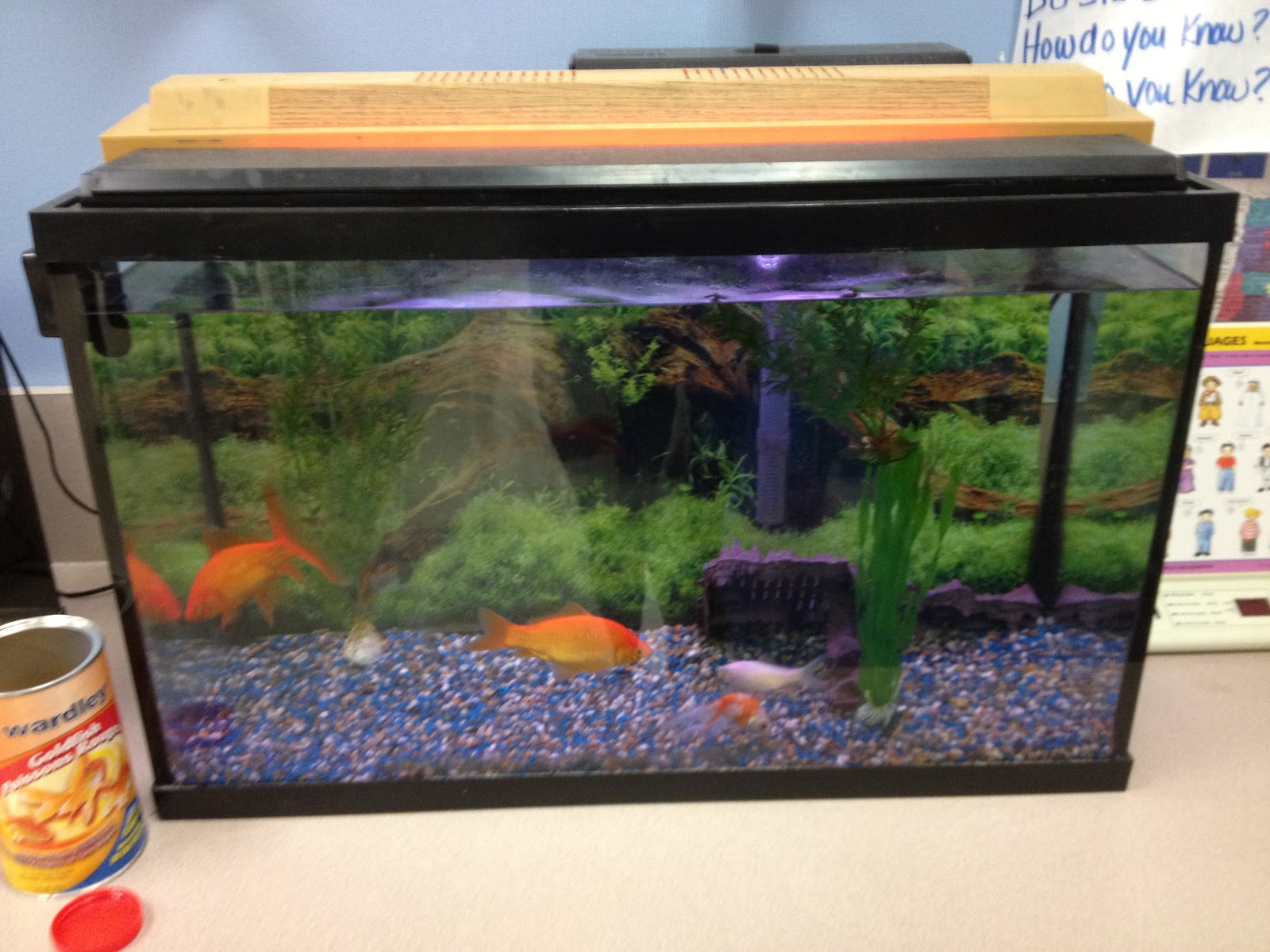
I started with a tank of goldfish and added a few other community fish to their tank.  Visit your local petstore to find the perfect fish for you (I suggest starting with something easy like Tetras, ghost shrimp, etc).  There can be a bit of a start up cost for getting fish (buying the tank, gravel, filter, light, plants, food, etc), but try posting something on Craigslist.  That's how I was given two bearded dragons, a cichlid fish, an oscar fish, 2 goldfish, an eel, and a Chinese algae eater for FREE!  A lot of families lose interest in fish after they've had them for a few months, but they want to give them to a good home.  What better environment than a classroom where they will be loved and adored by 30 students each day and carefully cared for and examined.  Check in with your community to see if there's anyone wanting to rehome their fish.  You can also look around 2nd hand shops, like Goodwill, for a used tank, because they almost have a great setup for a very reasonable price.

 This is my favorite fish, perhaps of all time, because of his amazing eyes.  His name is Calico, and he is fabulous.  Look at that tail! Fan-tailed goldfish are great.  One of Calico's eyes is a regular yellow eye, while the other is all black.  My students love when I talk about Calico being my favorite fish in a fake-whisper voice (so the other fish won't hear and get jealous).  I also pet this fish (it started on accident when I was moving the plants around the tank the first time, and now purposefully every so often for fun). He shares the tank with three other goldfish and one Chinese algae eater.  All of these fish are Community fish, so they get along well.

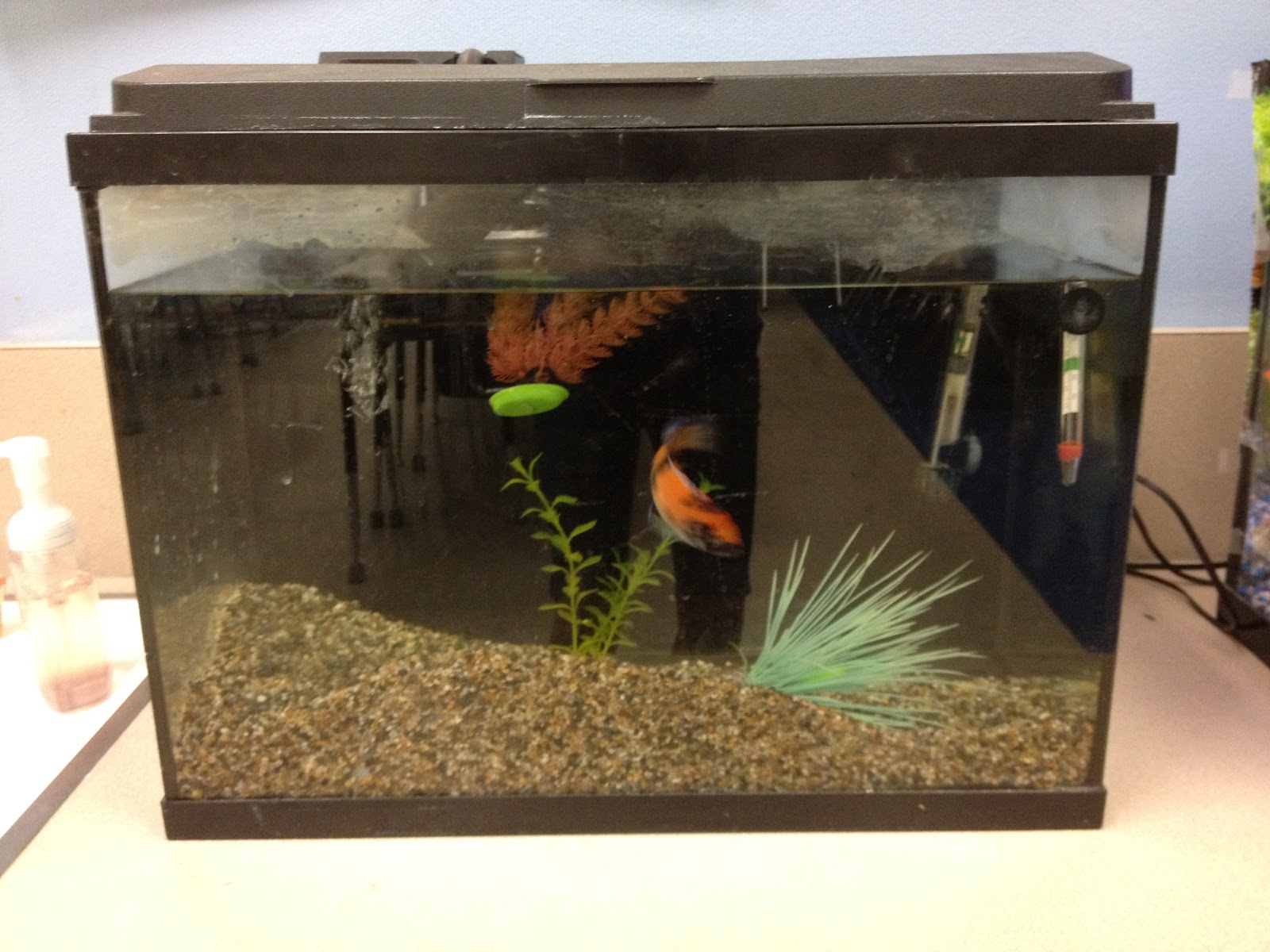
 Think about a variety of fish that will go well together.  Fish are generally categorized as Goldfish/Community OR Semi-aggressive OR Aggressive.  Your local pet store can help you find compatible fish.  Below is Bubbles, a cichlid, who shares his tank with an eel.  Bubbles is the only fish I've ever known who routinely rearranges his tank.  I knew Bubbles was unique when I looked over after school one day to see him pulling one of his tank plants to the other side of his aquarium WITH HIS MOUTH!  Fung-shui is very important to Bubbles and other cichlids, and they make for cool pets.


Fish are great because they are very low-maintenance.  I probably do about 10 minutes of work per month to care for them, because one of our classroom jobs is ZOOKEEPER!  This is one of the few jobs that I have two students cover (Zookeeper 1 & 2), so one of the students can care for Chubbs and the other can feed the fish.  Then at the end of the day, the other student feeds the fish.  Besides feeding them, that's all the students do.  The only thing I need to do is clean their filters about once a month and possibly change out some of the water.  You'll need to clean them more frequently depending upon the size of your tank and the type of fish you have; goldfish are notoriously dirty fish.  Still, 10 minutes of work to provide your students with a great topic to write about, an easy thing to have them "teach," a fun new organism to write about, and another fun memory from your classroom is definitely worth it!  Post an ad on Craigslist and see if you can add a cool new living feature to your classroom for free!

Wednesday, September 19, 2012

Student-Made Theme Books!

 What Are Student-Made Unit & Theme Books?
They are awesome.  These little books are very easy to make and cost about a penny each.  They help reinforce key ideas from whatever unit you are working in (I usually use mine for social studies, science, and health) and they help the students OWN the information.  It encourages creativity, reflections, fine motor skills, ELD, graphic organizer use, and some good, old-fashioned copying!  The day before the post test, each student can take home their theme book and study from it so they are ready to ace the test the next day, as well as show off their great work to parents at home.  These little books will make you look good on test scores and to parents!
  

How Do I Make Such an Spiffy Little Book for My Students?
Most schools keep the necessary supplies on hand-construction paper, blank white paper, and staples.  For most of mine, I just take a large piece of construction paper, and slice it in half.  Do that to 15 pieces of construction paper, and you have a class set of theme book covers!  Decide how many pages you want your book to have.  I usually want at least 6 pages (I make my students use the front and the back of each page).  For books that students will do a lot of writing in, like their Oregon Trail Journals that also have their journals as well as the info from the unit, I do 20 pages.  If you want 6 pages total, you'll just take 3 regular sheets of paper (in a cool color if you so choose), and fold them in half horizontally (hamburger way).  You just made the inner pages for the inside of your theme book!  I like to choose a color that has something to do with the unit we're learning about (like dark green cover and light green inner paper for Oregon, brown cover and tan inner paper for historical things like our Oregon Trail Journals & Corps of Discovery journals, and blue cover with white paper for our government books).  Tuck your inner papers inside the construction paper, and staple twice at the fold.  Done!  It's just that easy!  (The exception is the crazy Animal Classifications one picture above, I'll show you how to make it in another post).  I usually don't waste my students' time making these, but when I have former students come back wanting to volunteer in my classroom, or a random parent volunteer, or an awesome student teacher, I have them make a few class sets in a variety of colors.  If I don't use them this year, I'll sure use them next year.  Generally, I have the students do all the writing on their books, including the covers, that can look something like the picture above.

 What Do We Put in Them?
Anything & Everything.  If it's important, it's in the book.  Ideally, every answer on your post-test should be able to be gleaned from the pages of the almighty theme book.  Students will spend time on this.  They will labor over it, add more to it, decorate it, talk about it, teach someone else from it, and study from it.  I have very few student examples because NO ONE WANTS TO GIVE THEIRS UP!  They work hard on it and they keep them.  Here are some different examples of some things that could be included:

Venn Diagram comparing the life cycle of two organisms, complete with comparative sentence stems on the right side.

The names of Oregon Trail Landmarks along with a sketch of each...Dangers of the Oregon Trail, with a labeled picture for each.

Timelines of important events you want them to know for the rest of their lives (and the post test!)

Summaries of their textbook reading or a narrative input chart (look up GLAD strategies for that awesome tool!)

Labeled diagram of the life cycle of a Douglas Fir Tree and a salmon.

I'll do another post that goes through every page of an Oregon Government Book we are in the midst of teaching from, but the key to remember is that if it's important, it should be in the book.  You can have students teach a buddy (pair up with a younger/older grade classroom and have your students be the experts who are sharing their knowledge with their buddy).  This is NOT just a place for them to copy things from the board into their book without any actual teaching.  That has very little use.  This IS a great place to have students write reflections about what they've learned, write vocabulary words from the unit with pictures & definitions, copy down chants about the subject, write their related sentence stems, and record graphic organizers you've done as a class.  Theme books can make learning more fun, make studying easy, help parents connect with their child's learning, and will be a beloved memory of your students' time in your classroom.

Questions?  Have a cool variation or a different way you use theme books?  Please leave a comment, & remember to pass it on to others through Pinterest & Facebook!

Dictation ~ Dictado

Dictado Background
 Dictado (Spanish for dictation) has helped my students' writing skills grow significantly over the last three years I've been using it.  This blog is all about how I implement dictado in my classroom.  I am an ESOL teacher, not a bilingual/dual language/Lit2, and this year I have 2 Spanish speakers, 2 Russian students, 1 Mandarin speaker, 1 student who speaks Hmong, and one Dutch speaker!  If you want to help your students become more careful listeners, better writers, and better communicators, dictation is for you!


The Goods- Dictado Journal

I used steno pads for our dictado journals for the last 2 years, and they work really well.  The size of the page is perfect for one 3-5 grade length dictado.  This year, it was going to cost $2/steno pad, and because of budget cuts, I didn't want to cost the school anything extra.  Instead, I put the 60 spirals that I got for a penny each to use!  I'm also trying out the combination of the ELD (English Language Development) work along with the dictado in one spiral, and we'll see how it goes.  My awesome student teacher, Michele, labeled the class set, and then if the kids have extra time they can decorate their journal.  Here are 2 shots of the cover of my dictado journal.


I just have two sections for the journal- the front is for random ELD goodness and dictado practice (like the pretest, partner dictado, and other practice) and the back is for dictado post tests only.


Differentiation in Dictado
 Last year, I saw that some of my students were ready for a challenge, while others were failing every week (these were mostly my students who read/write at a first grade level, so making them write this fourth grade level dictado is unreasonable and unfair).  In the official dictado, there is no differentiation for students with different needs.  That's just silly.  So I made my own differentiation up.  This is why I have three groups for dictado- Foundations, General, and Challenge.  Foundations are my kids who work just on the first sentence of the dictado- we pour our attention and practice into that one sentence so they can be successful with it by Friday and actually learn something from it (rather than getting frustrated and just giving up).  The majority of my students are in the General group, and they do the first two sentences of the dictado.  These are my on grade level students.  Then there are my Challenge students, who are ready for the third sentence, which is usually high school level in terms of vocabulary and complexity of syntax.  To become a challenge speller, a student either has to get 100% on the first three dictado post tests of the year OR get 100% on the Challenge Dictado Week (which is about once every other month).  For that one test, every single student tries doing all three sentences, and if they get it right, they get 10 bonus Pioneer Dollars instead of just the normal 1 Pioneer Dollar that they usually get for earning 100% on any test.  If they get it, they become a Challenge dictado student and do all 3 sentences for the rest of the year.  Of course there are exceptions to all this, so use your professional judgement as you work it in your own classroom.


Dictado Schedule

Here is the run-down on the dictado schedule that I generally follow for each week:

Monday
Teacher administers pretest- The instructor reads the entire dictado (usually 3-4 sentences for 4th grade) aloud fluently.  Then the teacher reads the first sentence slowly, word by word, going just fast enough for the slowest writer in the class to just keep up.  Next, they read the sentence fluently again.  Follow this fluent, word-by-word, fluent pattern for all the sentences.  The last thing to do for the pretest is to read the entire dictado fluently one last time.  You will need to do a lesson (probably after the first one) about teaching students to listen to your voice to hear pauses (commas or semicolons go there!), all the sounds in a word, etc.  This is a perfect time to teach them about capitalizing the title, starts of sentences, & proper nouns. Dictado is the time to teach indentation, homophones, and language patterns.  The teacher writes the dictado based upon what the students are struggling with, so it's geared exactly to the class needs.
Mini-Lesson-  Once the pretest has been administered, the teacher gives a brief lesson on the focus for the week- capitalization of proper nouns, your/you're/you are, there/their/they're, use of semicolons, how to use quotation marks, how to spell key vocabulary words...whatever your students need!  I usually write my dictados about whatever our social studies/math/science unit is so they get content along with the writing lesson.
Students Copy the Dictado- Students write the dictado from the board (I have mine typed up on my SmartBoard and on my class website each week) right below their pretest.  I have my students write it in green felt tip pen ("Editing Marker") and I expect them to write it perfectly as they're just copying it from the board.
Students Edit their Dictado-  Next, students read through their pretest and correct any mistakes they've made using the editing marks (we have a poster of the editing marks and most of them are already familiar with them)

Tuesday
Students just copy down the dictado on a 1/2 sheet of paper to take home to study from.  I sometimes have them body spell the dictado on Tuesday morning to connect with the passage more kinesthetically.

Wednesday
Partner Dictado-  The students pair up and take turns dictating to each other in the front of their ELD/Dictado Notebooks (write your email in the comments if you want a copy of the instructions I post for students to remind them what a good partner dictado will look like).  Then they trade and correct each others work using the correctly written dictado from Monday.  This is when I pull my intervention/Foundations group and I dictate it to them while hinting at the language focus for the week.  Then I correct each Foundation student's dictado and discuss the results, reteaching if necessary and mostly giving more language pattern tips.  I sometimes have my students write something to the effect of, "Today during partner dictado, I was still tricked on _____________.  On Friday, I will make sure that it doesn't trick me by remembering ___________________________."

Thursday
During school, students write the dictado on a 1/2 sheet of paper to study from that evening.  Their homework for the night is to study the spelling words and the dictado, and to turn in whatever they did to study the next morning.  I have a long list of different ways to study; leave a message with your email if you'd like them!

Friday

Teacher Administers Post Test- The teacher administers the post test in the same fashion that they did on Monday.  This time, students leave their dictado open to that testing page and turn it in to the teacher, who grades it.  The teacher simply edits the work carefully, and marks how many mistakes (a misspelled word counts as -1, incorrect capitalization -1, forgot to indent -1, etc) there were total.  Celebrate the improvement from Monday, and remind students that they can use the language patterns that they've learned in dictado this week in their writing for the rest of their lives!
Questions about dictado?  Leave a comment!  Happy writing to you and your students. :)